1.26.2016

Building the layers (az)


  As I thought of my artistic process in creating this piece, it made me think of 
archaeology - carefully digging through the layers of dust and dirt.
Except I am building (as opposed to excavating) up layers over time with pastels, graphite, fixative and telling an artistic history. 

Over a decade ago, I took a portrait class.  In the fall of 2014, I dug out this pastel from the class and I started to rework it. Parts of the face were not lined up so I corrected what I could.  I wanted more detail than I could get with pastels, so pencil was used for more graphic lines. Recently, I found it again and proceeded to work on it with more pastel, pencil and fixative. I usually do not like it when the mistakes and lines show through the pastels and fixative but with this work I do. To me the layers of the work are the most fascinating and the layers tell story.

It still is not done. The story continues.


1.19.2016

metal head -kes

Years ago while taking my work out on the road to fine art and craft fairs, I was taken by a fellow exhibitor's work at the Lyndhurst Castle Artrider Festival He made human scale flowers cut out of metal with a plasma cutter. These forms had all the appeal of Alice in Wonderland scale plus fire to make them. What's not to love? It's been over a decade since then and the desire to play with fire and metal isn't getting better. Actually it's worse since starting a visual arts master's degree at New Hampshire Institute of Art. Now there is a really good excuse for it at least. Carpe diem.

Plasma cutting is still on the back burner but metal and fire in the form of welding need not wait a moment longer. Its cold outside but the game is afoot. Don is my teacher and I am ever the humble student. We ran out of wire and got pretty cold but this post contains the first attempt at making some beads, attaching 2 pieces, and filling a gap. Raw and beautiful. Welding 101 begins.


1.12.2016

Paper Fun (SKF)


 January Salutations,

    Here's some paper models that pepper my studio. I have it in the back of my head to make larger versions of these for a parade or  temporary sculptures for festivals.I thought the corrugated plastic used for outdoor signs would work great. They could be made out of aluminum for some backyard excitement. Make your colors crazy!
 
  I love cut paper to create spinning ornaments. The one to the left is from an old Christmas chocolate box. Each arm has a hole in the center with a straightened paper clip through the middle. The most important thing to remember is balance, the weight must be equally distributed around the pivot point.
   
 The holographic whirly gig is a four armed spiral connected into a ring at the bottom. You can tape the bottom of the arms into the ring or make half circle tabs that catch each other. I used old wrapping paper for this fun creation. Recycled Christmas cards would be interesting. You should see the rainbows that reflect off of the surface when the sun hits. Way better than Polyanna's crystals!.
 
 The stands are piece of found PVC with a hole drilled into the center and a straight wire shoved into to the hole. Then a simple drinking straw placed over the wire is as good as any bushing. The center pins as you can see are either a push pin or I used a stud earring blank with the backing holding it in place.

Make some hot tea and experiment. Great fun for a gray day.


1.06.2016

Starting a new journal (az)

I started a new art journal.  This incomplete creation has hinged pages covering the main work.  This is it with the pages opened. I used craft paint, metallic paint, an envelope window, scrap booking pieces, and punch pieces for this piece. The letters on her neck and chest are cast-offs from Sarah (from one her many projects) and deeply appreciated.  I am working with idea of illuminated text but I usually don't use a lot of words or writing in my art. This allows me to cheat a little using Sarah's letters. 


With just one page covering...


I think the page is more interesting with both pages closed. 


12.23.2015

mother of dragons-kes

question: what can be made? answer: what ever can be imagined.

this is an industrial printer. it lives at work. not much love for it.


this is what the printer looks like inside. notice the black ribbon waste top center. 
after ink is used once, it rolls up onto the top waste spool.


this is what happens when the artist defiantly gets 'cooking' and 
refuses to put trash in a landfill just once.

egg recipe:
  • [1] industrial waste ribbon-wound on itself like a baseball core
  • add scotch tape reinforcement
  • coat in matte medium
  • embellish with glue gun
  • apply acrylic sealer
  • spraypaint
nest recipe:
  • [2] styrofoam plates, torn, previously used as painting palletes
  • torn pieces of multilingual handwritten letters & songs on paper
  • rose petals
  • matte medium
  • apply acrylic sealer
  • spraypaint
assembly: 

to taste


signs of life
mixed media sculpture assembly, 2015


12.15.2015

Work in process - Kimono (az)

'Kimono' was inspired by 'Memoirs of a Geisha'. 
I had forgotten about this until I went through my computer files. My creation is hardly accurate and unfinished. 
 I  used pencil, charcoal, pastel, watercolor, and black pen on sketch paper. I also used workable fixative which is not so workable with black pen but I am hoping to complete this.


12.08.2015

Components and Composing (SKF)

Greetings Fellow Creatives!

As you can see, I went to THE Museum of Fine Arts on Sunday to view the Dutch Masters. While I was strolling through the galleries, I observed a visual thread that seemed to originate in the paintings of Vermeer and de Hooch and was later reinvented in the works of Piet Mondrian.
This way of abstracting structure is very much operating in my own work. If you look at the painting to the left, "The Astronomer" by Johannes Vermeer, the composition shows large almost geometric shapes made by the chair, the back wall, back cabinet and the rectangular painting which visually hems our astronomer into place. He has a gridded window onto the world and by touching a globe, through the arrangement of diminishing puzzle pieces  we can visually feel the acceleration of his mind imaging enormous spaces. beyond his cramped interior.
In this painting, "Two Women Beside a Linen Chest with a Child" by Pieter de Hooch, the interior is neatly organized into sensible grids that relate in layers as you move through the space towards the back room. Notice the small patch of  blue sky in the middle of the painting. I am reminded of virtual landscapes of the online games which seem to employ similar compositions.
Compare the two styles below, de Hooch on the left and Mondrian on the right. All of these paintings organized the space by the mapping and the measurement of portions in relation to the whole. The architectural designs of  Theo Van Doesburg, founder of the De Stijil movement demonstrates how this way of  abstractly composing can create Modern Architecture. The fitting together of bits like the pixels in a digital photograph started with this idea of components. Now we find it difficult to see in any other way and I think it started in the small quiet interior paintings from a nation that once ruled the oceans from their tiny little row houses.



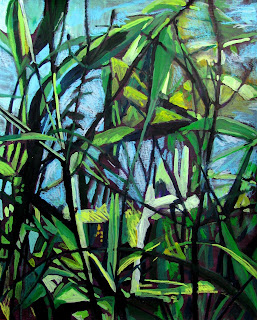
 So the nature of how you divide up the whole becomes an understanding of  inherent structures. These constructs exist at many layers with the human mind jumbling the pieces and reassembling them over and over in new ways.
 Each time the tangram is put together, new relationships are seen. We find pleasure in making new files in our imaginations to view the whole in a different light.  As fresh images inspire new harmonies, there is a never ending supply of wonder to fuel the artistic heart.
At every scale no piece is expendable and all parts are inseparable from one another and the Whole. For me observing the infinite flux of these patterns is a doorway to the presence of the Ineffable and a modern take on what we can't know but it has never stopped us from trying.